Neuromarketing Research
The NeuroMap® framework — decoding how the Primal Brain actually decides.
NeuroMap® — A Complete Science of Persuasion
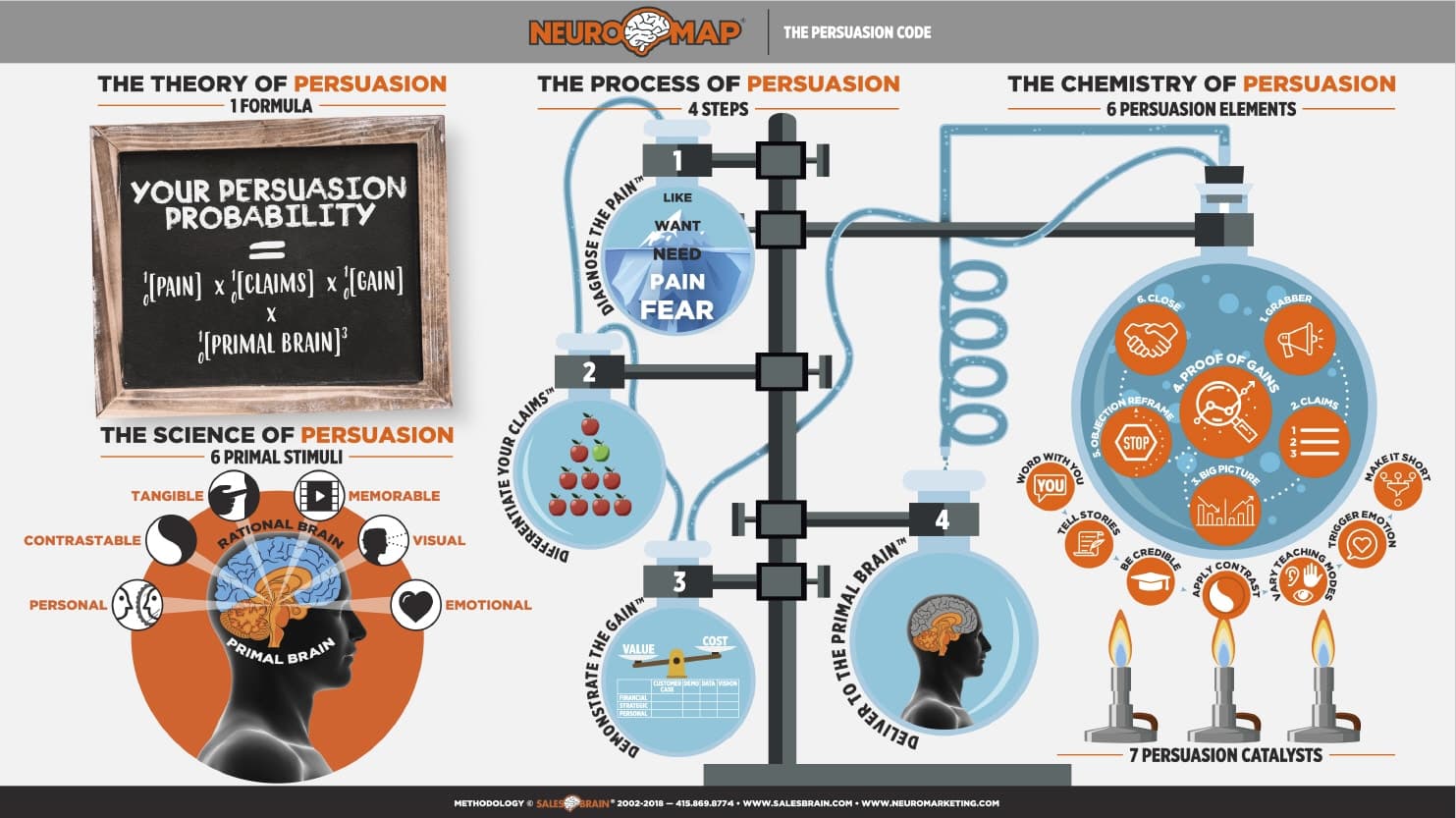
NeuroMap® is a proprietary persuasion model built on cutting-edge neuroscience and media psychology. It targets the Primal Brain — the part of the brain that drives most decisions but operates below conscious awareness.
Ancient. Fast. Decisive.
The most primitive part of the brain — responsible for survival functions and the true seat of every buying decision. It doesn't read or analyze; it scans, feels, and decides.
Rational. Slow. Easily Fooled.
The cortex processes language and logic — but it doesn't make decisions. It rationalizes them after the fact. Most marketing targets the New Brain and wonders why it fails.
The Brain's Native Language
Six triggers that activate the Primal Brain. Master these and your message speaks directly to decision-making.
Personal
“The Primal Brain is a very self-centered entity.”
It prioritizes its own survival above all else. Messages that speak directly to the individual cut through instantly.
Contrastable
“Before/after, with/without — contrast enables quick, safe decisions.”
Sharp differences let the Primal Brain decide without confusion or mental exhaustion.
Tangible
“The Primal Brain scans constantly for what is familiar and concrete.”
Abstract ideas don't register. Only concrete, recognizable concepts actually land.
Memorable
“The Primal Brain forgets most of the information it must process.”
Key messages must appear at the beginning and end — everything in the middle is largely lost.
Visual
“The Primal Brain is highly visual.”
Visual input reaches decision-making centers first — faster and more powerfully than words.
Emotional
“Strong emotions create hormones that act as a memory maker and decision trigger.”
Emotion is not a bias — it is the primary engine of decision. No emotional trigger means no action.
From Pain to Close
SalesBrain's proven methodology for navigating customer brains — from uncovering pain to closing with clarity.
Diagnose the PAIN
No PAIN, No Gain.
Identify the source, intensity, and consequences of customer pain. No identified pain = no motivation to change.
Differentiate Your CLAIMS
No CLAIM, No Fame.
Articulate three unique capabilities that address each pain. Claims must be therapeutic, original, and provable.
Demonstrate the GAIN
No Evidence, No Confidence.
Prove value through financial ROI, strategic advantages, and personal benefits — in that order of credibility.
Deliver to the Primal Brain
No Clarity, No Close.
Present with maximum clarity so the Primal Brain can quickly understand and commit — without confusion or overload.
The Messaging Architecture
A proven structure that targets the Primal Brain at every stage of a sales or marketing interaction.
The Grabber
Grab attention at the very start. Five proven methods trigger customer interest before a single claim is made.
Claims
Short, relevant claims that are Therapeutic (solve pain), Original (differentiate), and Provable. Repeated for reinforcement.
Big Picture
A single visual that conveys value with minimal text — or a before/after contrast showing pain, then relief.
Proofs of GAIN
Communicate Financial, Strategic, and Personal gains. Ranked by impact: testimonials, demonstrations, data, vision.
Handling Objections
Objections stem from perception and fear. A structured process addresses both misunderstandings and fear-based resistance.
Close
Revisit pain, claims, and gain. End with two powerful questions: "What do you think?" and "Where do we go from here?"
Amplify Every Message
Techniques that boost the Primal Brain's response to each Persuasion Element.
Use "You"
Personal language makes customers take ownership. The Primal Brain responds only to itself.
Be Credible
Master six factors: Creativity, Fearlessness, Passion, Integrity, Accessibility, Expressiveness.
Apply Contrast
A sharp before/after between pain and relief dramatically increases message impact.
Trigger Emotion
Reenact customer pain. Emotional responses drive memory formation and decisions.
Vary Teaching Modes
Changing instructional styles keeps audiences engaged and accommodates different learners.
Tell Stories
Stories make concepts visual, tangible, and emotionally resonant — soft but highly effective.
Make It Short
Remove everything non-essential. More impact delivered in less time.
Get the Neuroscience of Persuasion — Direct
Research-backed insights on neuromarketing, AI, and decision science. No fluff. Sent monthly.
No spam. Unsubscribe anytime.